


ASTM B 381 Titanium Forged Ring
Product name: ASTM B 381 titnaium forged ring
Standard: ASTM B381 / ASME SB381;ANSI / ASME B16.5
Thickness: 40-400mm
Materials: Gr1, Gr2.
Dimension: Customized.
Personalized customization is available
Product Introduction
What are ASTM B 381 Titanium Forged Rings?
ASTM B 381 Titanium forged rings, also known as titanium cylinders, are manufactured using a forging process and are characterized by thick walls and a height smaller than their diameter. These rings are widely used in oil, deep-sea, and chemical pressure equipment, capable of withstanding high pressure and highly corrosive environments to ensure long-term stable operation. Common types of titanium rings include forged titanium rings, seamless rolled titanium rings, and cast titanium rings. Their applications span seawater desalination, water treatment, shipbuilding, power generation, aerospace, military, and chemical processing. Thanks to their lightweight design and excellent corrosion resistance, they have become key components in modern industry.
Titanium alloy forged rings are mainly divided into three types: seamless rolled titanium rings, forged rings, and cast rings. Among them, the manufacturing process of seamless rolled forged rings is particularly critical. Holes are cut into the forging material, which is then processed into a thin ring using rolling technology. Compared with traditional plate-sintered or butt-welded rings, this process significantly improves the concentricity and surface smoothness of the ring, making it more advantageous in precision assembly and high-pressure sealing applications. The choice of titanium material directly affects its performance. The four grades (grades 1, 2, 3, and 4) of industrial pure titanium (titanium content at least 99%) have slight differences in chemical composition, which in turn affects mechanical properties and design capabilities.
Among all industrial pure titanium grades, Grade 2 titanium alloys are the preferred material for most industrial applications due to their excellent ductility and corrosion resistance. Titanium alloys exhibit superior corrosion resistance compared to stainless steel in most environments and are lightweight, making them particularly suitable for fields with stringent requirements for material strength and environmental adaptability, such as aerospace, deep-sea equipment, and chemical equipment. These properties enable titanium rings to maintain stable performance even under extreme operating conditions, meeting the diverse needs of high-end manufacturing.
Our Products

China ASTM B 381 titanium forged ring

Titanium forged ring supplier

Finished product of forged titanium ring
Products Description
|
Product Name |
Dimensions(mm) |
Grade |
Standards |
|||
|
Titanium Forged Rings |
Outer Diameter |
Inner Diameter |
Height |
Thickness |
||
|
200~400 |
100~300 |
35~120 |
40~150 |
GR1,GR2, Gr5,Gr7,Gr12 GR1,GR2,Gr5,Gr7,Gr12 |
ASTM B381/ASME SB381 |
|
Chemical Composition % of Titanium Forged Ring
|
STANDARD |
CHEMICAL COMPOSITION (weight %, ma√ or range) |
||||||||||
|
Grade |
UNS |
N |
C |
H |
Fe |
O |
Al |
V |
Pd |
Mo |
Ni |
|
No |
|||||||||||
|
GR1 |
R50250 |
0.03 |
0.08 |
0.015 |
0.2 |
0.18 |
|||||
|
GR2 |
R50400 |
0.03 |
0.08 |
0.015 |
0.3 |
0.25 |
|||||
|
GR 3 |
R50550 |
0.05 |
0.08 |
0.015 |
0.3 |
0.35 |
|||||
|
GR 4 |
R50700 |
0.05 |
0.08 |
0.015 |
0.5 |
0.4 |
|||||
|
GR 5 |
R56400 |
0.05 |
0.08 |
0.015 |
0.4 |
0.2 |
5.5-6.75 |
3.5-4.5 |
|||
|
GR 7 |
R52400 |
0.03 |
0.08 |
0.015 |
0.3 |
0.25 |
0.12-0.25 |
||||
|
GR 9 |
R56320 |
0.03 |
0.08 |
0.015 |
0.25 |
0.15 |
2.5-3.5 |
2.0-3.0 |
|||
|
GR 12 |
R53400 |
0.03 |
0.08 |
0.015 |
0.3 |
0.25 |
0.2-0.4 |
0.6-0.9 |
|||
|
GR 23 |
R56401 |
0.03 |
0.08 |
0.0125 |
0.25 |
0.13 |
5.5-6.5 |
3.5-4.5 |
|||
Industry and Application
ASTM B 381 Titanium forged rings, with their superior high-pressure resistance, wear resistance, and corrosion resistance, have demonstrated wide application value in various industrial fields. In particular, these forged rings are key components in oil drill pipes, oil exploration equipment, oil drilling platforms, vacuum coated pipes, mining machinery, coal chemical plants, and natural gas drilling equipment, ensuring the stable operation of equipment under extreme environments.
Titanium forged rings (such as F-2 grade) in ASTM B381 standard are ideal for weight-sensitive applications due to their low density. In the medical and aerospace fields, this type of material is a core element for achieving lightweight design, supporting the performance optimization of high-end medical devices and aircraft. Medical devices such as implants and surgical instruments rely on their biocompatibility, while aerospace components utilize them to reduce structural weight and improve fuel efficiency. Meanwhile, the excellent strength and corrosion resistance of F-2 grade titanium forged rings make them widely used in industries such as marine engineering, chemical processing, and seawater desalination. Typical applications include oil and gas components, reaction vessels, pressure vessels, piping systems, heat exchangers, linings, and flue gas desulfurization systems, ensuring long-term stable operation of equipment in harsh environments.
Furthermore, ASTM B381 titanium forged rings exhibit exceptional adaptability to high-temperature environments, with continuous operating temperatures up to 800°F (approximately 423°C) and the ability to withstand occasional intermittent operation at 1000°F (approximately 573°C). This characteristic significantly expands their application range in high-temperature industrial scenarios, such as chemical reactors and energy equipment, where the material maintains structural integrity under extreme temperatures, making it an indispensable key choice in modern industry.
Processing of titanium forged rings
The manufacturing process of titanium forged rings involves multiple precision steps. First, the billet is heated and then repeatedly upsetting and chamfering. Next, a die is used to enlarge the center hole of the titanium forging billet, ultimately forming a semi-finished product. These semi-finished products then enter the inspection and packaging process to prepare for subsequent transportation.

According to ASTM B381 standard, titanium alloy forging involves a series of key processes:
Thermoforming process: For large-size titanium rings, the heating temperature is controlled below the β phase transformation point (usually 900-950℃). The wall thickness is ensured by multiple rolling passes through a radial-axial ring rolling mill, the deformation amount does not exceed 70%, and the cooling is completed by air cooling or temperature-controlled slow cooling.
Cold forming process: suitable for thin-walled precision ring parts, covering cold rolling/spinning and machining; when the cold rolling deformation reaches 30%, intermediate annealing (700-800℃/1h) is required, and machining is carried out with carbide or PCD tools, using a low-speed, high-feed operation.
Heat treatment processes: include solution treatment (water quenching at 930-950℃ for 1 hour), aging treatment (air cooling at 500-600℃ for 2-4 hours), and stress-relief annealing (550-650℃ for 1-2 hours after cold working), which significantly improves the overall performance of the material.
Surface treatment: Electrolytic polishing (surface roughness Ra≤0.4μm) and passivation treatment (nitric acid immersion to form a dense oxide film) enhance corrosion resistance and ensure product reliability in harsh environments.
These processes collectively ensure the performance of ASTM B381 standard titanium alloy forged rings in high-end fields such as aerospace and medical, meeting stringent requirements for strength, corrosion resistance, and lightweight.
Why choose us?
has been deeply involved in the titanium materials field for over 30 years, becoming an industry benchmark thanks to its profound technological accumulation and innovative strength.
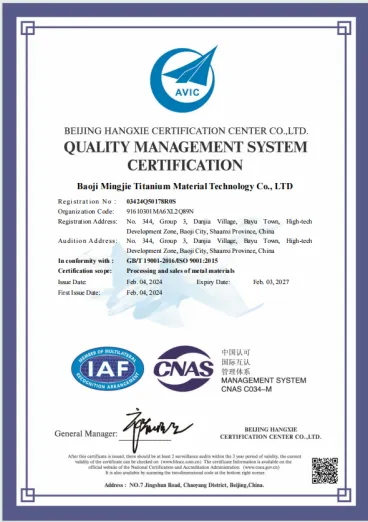
Our company's products boast significant advantages: leading technology, employing advanced forging processes to ensure high strength and corrosion resistance of titanium alloy materials, widely used in high-end fields such as aerospace and medical; superior quality, strictly adhering to international certification standards such as ISO9001, with comprehensive quality control from raw materials to finished products, ensuring stable and reliable product performance; timely delivery, possessing an efficient production system and supply chain management to ensure on-time order delivery and meet urgent customer needs; and service guarantee, providing comprehensive pre-sales consultation and after-sales support, quickly responding to customer issues, and building long-term trust relationships.
Choosing Baoji Mingjie means choosing a double guarantee of superior quality and excellent service.

Our Certificate


Hot Tags: astm b 381 titanium forged ring, China astm b 381 titanium forged ring manufacturers, suppliers, factory, titanium forging AMS 4911, titanium forging flanges, titanium forging custom specifications, titanium forging AMS 4918, titanium forging rapid prototyping, titanium forging energy
You Might Also Like


Send Inquiry
