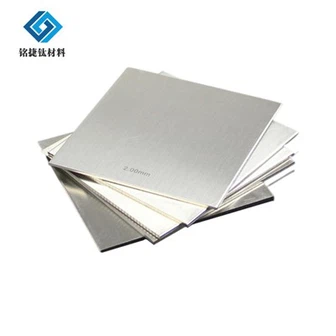
How to choose the right titanium grade?
If you have completed your research and determined that titanium is the metal suitable for your next product, however, this is just the first step. You still need to make some important judgments and decisions.
There are multiple grades of commercially pure titanium and titanium alloys. In order to apply it in the appropriate field, you need to choose the corresponding appropriate performance and grade.
While all grades of titanium alloy are corrosion-resistant, strong, and lightweight, there are some significant differences between them that can affect their uses, applications, and performance. When choosing a titanium alloy grade, it is important to consider the metal's intended use, the conditions in which it will be used, and the size of the titanium alloy part.
However, pure titanium comes in four grades, each with different properties suitable for different applications and fields.
Below, we have compiled commercial pure titanium and many of the most common alloys, including common product forms and applications. Understanding these characteristics and their application performance can help you select the appropriate titanium alloy grade.
Grade 1.
titanium alloy, also known as commercially pure titanium (CP titanium), is a high-purity titanium alloy with low density, excellent corrosion resistance, and good machinability. It is widely used in aerospace, medical, chemical, and other fields. Common grades include UNS R50250, ASTM B348, ASTMF67, etc. It is also known as Timetal 35A, Titan Grade 1, or Allvac 30.
Grade 1 titanium alloy is the softest grade of titanium alloy, making it extremely formable. It exhibits high ductility while still maintaining the necessary impact toughness. This grade is most commonly used for sheet, tube, pipe, and a range of other applications requiring high weldability and formability.
This titanium metal is used in a variety of industries, and its properties make it an effective choice for:
This titanium metal is used in a variety of industries, and its properties make it an effective choice for:
Grade 2.
For a slightly stronger metal, choose grade 2 titanium. It still offers good ductility, but with higher tensile strength. Grade 2 titanium is widely available, making it more affordable than other grades. Common product forms include bars, billets, plates, and wire.
It has many of the same applications as grade 1 titanium, though it is also used in:It has many of the same applications as Grade 1 Titanium, but it is also used for:
1.power generation 2. hydro-carbon processing 3. exhaust pipe shrouds 4.airframe skin
Grade 3.
Grade 3 titanium is not used near as much as grade 2, but it still has its uses. It is stronger than grades 1 and 2, features good weldability, and extremely high corrosion resistance. It is less moldable than the other 2 grades, but the added strength and resistance make it a good choice for:
1.chemical processing 2. marine applications 3. aerospace
It can be purchased in bar, billet, ingot. plate, and welded products.
Grade 4.
Grade 4 titanium is the strongest pure grade titanium, but it is also the least moldable. Still, it has a good cold formability, and it has many medical and industrial uses because of its great strength, durability and weldability. Grade 4 titanium is most commonly found in:
1.surgical hardware 2.heat exchangers 3.CIP equipment
CIPIt can be purchased in bar, billet, ingot, plate, and strip.
Titanium alloy
Titanium alloys are based on titanium (Ti) and are formed by adding elements such as aluminum (Al), vanadium (V), molybdenum (Mo), nickel (Ni), and tin (Sn). Their core advantage lies in retaining the lightweight (density approximately 4.5g/cm³), high strength (tensile strength up to 1200MPa), and corrosion resistance (forming a dense oxide film on the surface) characteristics of pure titanium while further optimizing their performance through alloying.
Titanium alloy is an alloy composed of titanium as the matrix and other elements.
According to the different added elements, titanium alloys can be divided into the following categories:
Classification of common alloying elements
α-stabilizing elements: aluminum, carbon, oxygen, and nitrogen, which can increase the phase transition temperature and enhance high-temperature stability.
β-stabilizing elements: molybdenum, niobium, vanadium, chromium, manganese, copper, iron, silicon, which can lower the phase transition temperature and improve plasticity.
Neutral elements: zirconium and tin, which have no significant effect on the phase transition temperature and are mainly used to adjust the organizational structure.
Grade 5.
Ti 6AI-4V (also known as Grade 5) is the most common titanium alloy and is known as the "workhorse" of the aerospace industry. It can withstand temperatures up to 600 degrees Fahrenheit (274 degrees Celsius), is strong, lightweight, easily formable, and highly corrosion-resistant. It is a blend of titanium, aluminum, vanadium, and iron.
Grade 5 steel is widely used in the aerospace industry to manufacture aircraft turbines and structural components, but is also used to manufacture high-performance engine components, sports equipment, biomedical implants, etc. Common product forms include bars, billets, foils, plates, seamless tubes, wire rods, plates, etc.
Grade7
Grade 7 titanium alloy is the most corrosion-resistant titanium alloy. It possesses most of the properties of grade 2 pure titanium, but the added palladium element helps improve weldability and formability. Grade 7 titanium alloy is most commonly used in chemical production equipment and is suitable for various product forms.
Grade12
Grade 12 steel has a strength similar to that of 300 series steel, and it boasts excellent formability and weldability, making it an ideal choice for various manufacturing applications. Its high corrosion resistance also makes it a common choice for the following applications:
heat exchanges chemical manufacturing marine applications aerospace applications
It can be purchased in bar, billet, plate, strip, wire, and welded pipe and tubing.
Ti 6AL-4V ELI (or 23 grade)
Ti 6AL-4V ELI (or 23 grade) is typically formed into coils, strands, wires, or flat wires. It is composed of titanium, vanadium, and aluminum, offering extremely high tensile and yield strength, but with lower ductility and weldability. It also possesses unique biocompatibility, making it widely popular in many medical and dental applications, including:
surgical staples ligature clips pins and screws and more
It can also be used to manufacture aircraft components and bulletproof armor. It can be used in the most common product forms, including seamless pipes
Other titanium alloys
While the most common titanium alloys are listed above, there are many other lesser-known and less widely used titanium alloys. Titanium alloy grades range up to grade 38, with properties and applications varying depending on the alloy metal.
When determining the right grade of titanium or titanium alloy for your project, consider the environment it will be used in, the part's intended use, and the size of the part required.
If you have additional questions or you're ready to make your titanium or titanium alloy order,pls feel free to inquire us or you can visit our website www.major-ti.com!