Titanium alloy welding technology: breaking through process bottlenecks and achieving intelligent and precise control
Titanium alloys, with their exceptional strength, corrosion resistance, and biocompatibility, have become irreplaceable strategic materials in the aerospace and medical fields. However, during traditional additive manufacturing, this material is prone to forming a directional columnar crystal structure-like a cookie cut by neatly aligned parallel lines. This microstructure causes the material to fracture preferentially along the grain boundaries when subjected to load, significantly reducing its mechanical properties and reliability.
Recently, Harbin Institute of Technology and Politecnico di Milano published a study in the international journal "The International Journal of Advanced Manufacturing Technology", which brought a "magic operation" to titanium alloy additive manufacturing - using pulsed micro-laser wire deposition technology to transform the grains of Ti-6Al-4V alloy from "long strips" to "rice grains", making it not only stronger but also more uniform in performance!

A breakthrough research team from Harbin Institute of Technology and Politecnico di Milano, published in the International Journal of Advanced Manufacturing Technology, has revolutionized the field of titanium alloy additive manufacturing. Using innovative pulsed micro-laser wire deposition technology, they achieved a fundamental transformation of the microstructure of the Ti-6Al-4V alloy, transforming the traditional columnar grain structure into a uniform equiaxed structure, much like reshaping neatly aligned pencil lines into the shape of plump rice grains. This structural optimization not only significantly enhances the material's mechanical strength but also achieves a comprehensive balance of properties, providing a more reliable solution for high-end applications such as aerospace and medical implants.

1. Triple technical barriers to titanium alloy welding
Titanium alloys exhibit excellent chemical inertness at room temperature, but when welding temperatures exceed 800°C, their material properties undergo a fundamental change, resulting in three core process challenges:
a. Oxidation pollution control
At high temperatures, titanium reacts violently with oxygen, forming a brittle titanium oxide (TiO₂) layer. This glassy substance significantly degrades the mechanical properties of the weld-when the oxygen content in the weld exceeds 0.15%, the material's impact toughness plummets by over 50%.
b. Hydrogen embrittlement sensitivity
During welding, hydrogen-containing substances such as moisture and oil decompose to release active hydrogen atoms. These atoms penetrate the crystal lattice to form hydrides (TiH₂), causing a sharp deterioration in the material's plasticity and toughness. Especially at low temperatures, hydrogen embrittlement can cause sudden fracture, with no obvious signs of plastic deformation on the fracture surface.
c. Thermal stress cracks
Although titanium alloys have a low coefficient of thermal expansion, the localized high temperatures associated with welding can still generate significant thermal gradients. When the heat input rate exceeds the material's plastic deformation capacity, residual stress concentrations form in the heat-affected zone, ultimately leading to intergranular crack propagation. High-speed welding or uneven cooling can further exacerbate this phenomenon.

2. Four core technical paths of titanium alloy welding technology
In response to the three major technical bottlenecks in titanium alloy welding, modern manufacturing has developed four types of targeted solutions:
a. Gas tungsten arc welding (TIG)
As the gold standard for precision welding, it is particularly suitable for thin-walled structures below 3mm (such as medical implants and aerospace precision components). Its core advantages are:
Arc stability with an accuracy of ±5%
Heat input can be precisely controlled within the range of 0.5-2kJ/mm
Adopt triple protection system:
• Main nozzle argon protection (15-25L/min)
• Back side argon filling protection (5-10L/min)
• Trailing hood protection (covering temperature > 400°C area)
b Vacuum electron beam welding
By creating an ultra-high vacuum environment (≤1×10⁻³Pa), we can achieve:
Electron beam energy density reaches 10⁶W/cm²
The weld depth-to-width ratio exceeds the 10:1 limit
Heat affected zone width <0.5mm
It is particularly suitable for key load-bearing structures such as 10-100mm thick plates and rocket fuel tanks.
c. Laser welding
Using high-energy laser beams (power 1-20kW) to achieve:
The welding speed is 3-5 times that of TIG process
Heat input can be controlled at 0.1-0.5kJ/mm
Requires dual airflow protection system (main protection gas + side purge gas)
It is typically used in mass production scenarios such as automotive titanium alloy chassis.
d. Diffusion welding
For dissimilar material connection requirements (such as titanium-steel, titanium-copper):
Process parameter window: 800-950℃/10-50MPa
The interface bonding strength can reach more than 85% of the parent material
Effectively inhibit the formation of intermetallic compounds
It is irreplaceable in fields with high biocompatibility requirements, such as medical bone nails.

3. Titanium Alloy Welding Process Parameter Standards
a. Current Specifications
1mm plate: 50-80A
3mm plate: 120-150A
Note: Excessive current will cause grain coarsening, while insufficient current will affect the penetration depth
b. Gas protection
Gas purity: ≥99.99%
Flow control: 20-30L/min
Key operation: Delay gas shutoff for 5-10 seconds after welding
c. Welding speed
Thin-walled parts: 50-100mm/min
Thick plate: 30-50mm/min
Speed influence: Too fast will easily produce pores, too slow will expand the heat affected zone
d. Groove treatment
Groove type: V-groove
Angle range: 60-70°
Blunt edge size: 0.5-1mm
Cleaning requirements: Stainless steel tools should be processed to a metallic luster, and barehanded operation is strictly prohibited.

4. Titanium alloy weld quality grade judgment standard
a. Silver-white weld
Features: Uniform metallic luster
Quality grade: Excellent
Application field: high-demand scenarios such as aerospace
b. Light yellow weld
Feature: Slightly oxidized color
Quality grade: qualified
Scope of application: Conventional industrial equipment
c. Golden-purple weld
Characteristics: obvious oxidation and discoloration
Quality level: Testing required
Processing requirements: Mechanical properties must be verified
d. Blue-gray weld
Characteristics: Severe oxidation
Quality grade: unqualified
Handling measures: rework immediately
Technology development trend
Modern welding technology has achieved three major breakthroughs:
Parametric control system replaces empirical judgment
Vacuum welding robots achieve micron-level accuracy
Real-time oxidation monitoring system ensures stable quality
With the development of emerging fields such as new energy vehicles and hydrogen energy equipment, titanium alloy welding technology will continue to innovate and promote the application of this high-performance material in more industrial scenarios.
However, if you need related titanium materials, such as titanium plates, bars, wires, foils, etc., you can browse our website www.major-ti.com and contact us at any time. We will do our best to serve you and provide the best products and prices. Welcome to visit us!
Here is the brief overview of our company!
1. Main products and core technology advantages
Baoji Mingjie Titanium Material Technology Co., Ltd. focuses on titanium and titanium alloy processing, and its main products include titanium plates, rods, wires and standard parts, which are widely used in chemical, medical, aerospace and other fields. Its core technology is reflected in:
Breakthrough in welding process: Triple argon gas protection TIG welding (argon gas flow rate 15-25L/min) is used to control the oxygen content of the weld to 0.08%-0.12%, which significantly improves the impact toughness of TC4 titanium alloy (≥90J/cm², exceeding the national standard by 50%).
Industrial chain coordination: Relying on Baoji Titanium Valley Industrial Cluster, we cooperate with Baotian Research Institute to develop a low-heat input welding process to solve the problem of thin plate deformation, and the products have been applied to UAV lightweight structural parts.
2. Quality control and industry certification
Traceability of the whole process: from titanium sponge raw materials to finished products implanted with laser traceability codes, in line with AS9100D aviation standards, the porosity of the weld of the titanium alloy aerospace fuel tank ≤ 0.5% (2% allowed by the national standard≤).
Green manufacturing: The recycling rate of welding titanium chips reached 85%, which is 20 percentage points higher than the industry average, and the ultra-low temperature welding process (-196°C) was tested to meet the needs of hydrogen energy equipment.
3. Market competitiveness and customer groups
Regional advantages: As a Baoji Titanium Valley enterprise, its customers include chemical equipment manufacturers, medical implant manufacturers and aerospace secondary suppliers.
Forward-looking technology: Prepare for the establishment of an intelligent welding demonstration line, plan to realize the automatic production of titanium-steel composite welding in 2026, and lay out the new energy and deep-sea equipment market.
4. Industry status and innovation potential
Baoji Titanium Industry has led the formulation of 4 international standards and 74 national standards, and Mingjie has strengthened the layout of circular economy by participating in regional technology upgrades (such as recycled titanium ingot standards). Its titanium products show differentiated competitiveness in precision control (micron-level welding) and applications in emerging fields (such as hydrogen energy storage tanks).
Then ,here is our product display, the display of our main products
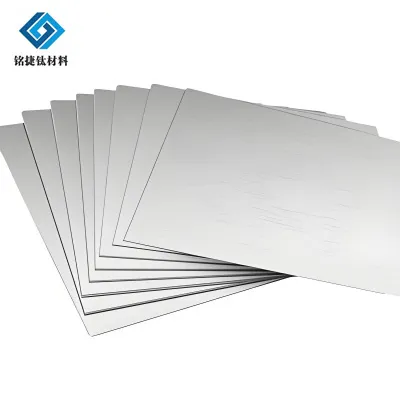
our main products titanium plate.

Gr1 titanium plate being packaged

Wooden case packaging of titanium plates

Titanium alloy plates being loaded

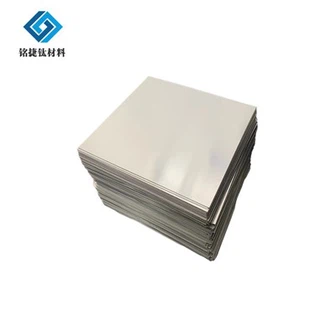
Gr5 titanium plate in stock

TC4 titanium plate packed in wooden case

GR2 Titanium Plate Stoc