Titanium alloys: properties that defy common sense
What comes to mind when you think of metals? Do you imagine them as rusty, heavy, and lacking warmth? Titanium alloys, however, defy convention-even after decades of immersion in seawater, they retain their original color and remain rust-free; they are as light as plastic yet stronger than steel; when implanted in the human body, they integrate perfectly with bone; and even more remarkably, they can display a vibrant, rainbow-like color transformation. What scientific secrets lie behind these seemingly counterintuitive properties? Today, let's uncover these mysteries together.
1. It does not rust when immersed in seawater.
While rusting is a natural law for metals, titanium alloys defy convention. After being submerged in seawater for ten years, their surfaces remain as bright as new; even buried underground for decades, they retain their original smoothness. Even more astonishingly, titanium alloys can be used to store nuclear waste-the highly corrosive nature of which would rapidly disintegrate stainless steel.
The secret lies in an invisible protective layer: once titanium alloy comes into contact with air, a thin oxide film, only a few nanometers thick (millions of times thinner than a human hair), immediately forms on its surface. This film acts like an indestructible "armor," completely isolating the titanium from external water, acids, and salts. Even more remarkably, if this film is scratched, the titanium quickly "summons" oxygen from the air to regenerate a new film at the damaged site-as if it possesses a "self-healing" ability.

2. The Reversal of Density and Strength Despite Being as Light as Plastic
Holding a titanium alloy eyeglass frame, you might question, "Is this really metal?"-its density is only 60% of steel (comparable to aluminum), yet its strength rivals that of steel. This "lightweight and high-strength" characteristic makes titanium alloy a favorite in the aerospace field: aircraft using titanium alloy fuselages can reduce weight by 30%; bicycle frames using titanium alloys are lightweight and durable, making riding feel like "nothing" is happening.
3. Can it be implanted in the human body and integrate with the bones?
In orthopedic surgery, titanium alloy is the only metal that can "coexist" with bone. When doctors implant titanium alloy artificial joints or dental implants into the human body, it does not cause rejection like stainless steel. Instead, it attracts bone cells to gradually cover the titanium surface, forming "osseointegration"-in short, the bone regards titanium as "one of its own" and "embraces" it tightly.

4. The "Optical Magic" and "Temperature Cultivation" of Titanium Alloys
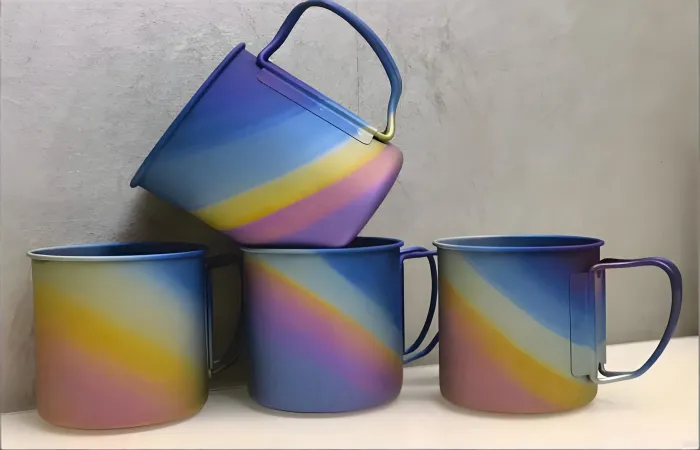
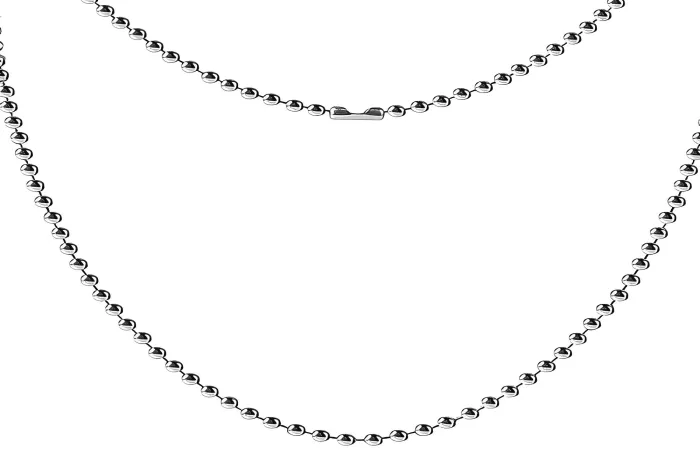
While ordinary metals require painting or electroplating to change color, titanium alloys can exhibit a rainbow of colors-pink, blue, green, and purple-through anodizing without the need for dyes. The principle behind this is that anodizing alters the thickness of the oxide film on the titanium surface. When light shines on films of different thicknesses, reflection and interference occur (similar to the color-changing properties of soap bubbles). For example, a 10-nanometer-thick oxide film appears golden, 30 nanometers appears blue, and 50 nanometers appears purple. This characteristic of "controlling color through thickness" makes titanium alloys a new favorite in the jewelry industry-titanium necklaces can change color depending on the angle, making them even more dazzling than diamond-encrusted necklaces.
5. Meanwhile, titanium alloys exhibit exceptional performance at extreme temperatures: most metals become brittle at low temperatures (e.g., iron is brittle at -27°C) and soften at high temperatures (e.g., aluminum softens at 100°C), while titanium alloys remain remarkably resilient. At near-absolute zero (-273°C), their toughness actually increases, making them suitable for liquefied natural gas storage tanks; at temperatures as high as 600°C, they retain their strength, which is crucial for the high temperature and pressure resistance of fighter jet engine turbine blades.

6. Titanium Alloys: From Rockets to Woks
A little over a decade ago, titanium alloys were only used in high-end fields such as rockets and fighter jets due to their high price (the cost of refining 1 ton of titanium is equivalent to 3 tons of steel). Today, titanium alloy frying pans and thermos cups can be bought for a few hundred yuan, and they have entered the lives of ordinary people.

7. The Truth About Titanium: Pure Titanium Has No Memory Function
Many people mistakenly believe that titanium has a memory function, but in reality, the material that can automatically return to its original shape after being bent is a "titanium-nickel alloy" (nickel-titanium alloy), while pure titanium does not possess this property. Some vendors have advertised that "titanium alloy eyeglass frames can automatically spring back," but users have found that they cannot return to their original shape after bending them. Remember: the advantages of pure titanium are "lightness, strength, and corrosion resistance," while "memory function" is a feature exclusive to titanium-nickel alloys.

These seemingly counterintuitive properties of titanium alloys do not violate the laws of physics, but rather represent new discoveries in human exploration of metals. From the self-healing ability of oxide films to the color-changing principle of light interference, and their stability in extreme environments, they all prove that metals are not just about "rusting, being heavy, and being cold."
Baoji Mingjie Titanium Materials Technology Co., Ltd.: A Leader in Titanium Alloy Technology
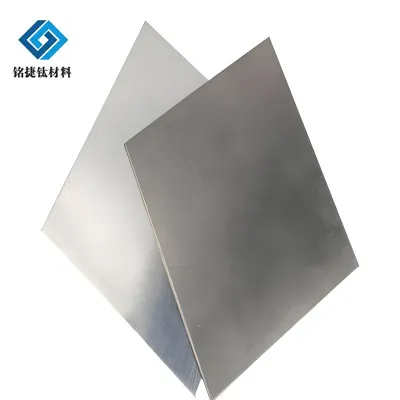
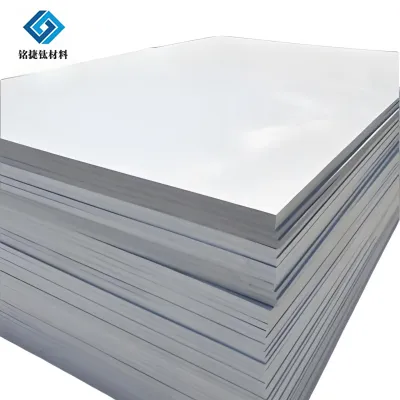
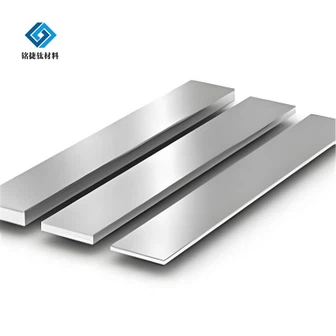
Titanium alloys are redefining industrial applications with their revolutionary properties-self-healing oxide film for corrosion protection, optical interference-based color-changing principle, and extreme temperature stability. As a professional titanium material supplier, Baoji Mingjie specializes in Gr1 to Gr7 titanium alloy plates, providing superior quality and cost-effectiveness to high-end fields such as aerospace, marine engineering, and medical implants, meeting the demands for lightweighting, high strength, and corrosion resistance.

Product advantages:
The full range covers plates from Gr1 (pure titanium) to Gr7 (titanium-palladium alloy), suitable for various application scenarios; large-scale production and local supply chain optimization ensure cost advantages, making titanium alloys an economical choice instead of an "exorbitantly priced metal".
Quality Assurance: A rigorous quality control system ensures that products undergo deep-sea corrosion testing (such as oxide film self-healing) and high-temperature and high-pressure verification (stability from -250℃ to 600℃), guaranteeing long-term service reliability.

Technical support:
The company is equipped with internationally advanced titanium processing equipment and employs precision rolling and surface treatment technologies to achieve nanoscale oxide film control (supporting rainbow anodizing) and the ability to form complex structures. From deep-sea equipment to civilian innovation, Baoji Mingjie uses counterintuitive properties as its foundation to help customers break through the limits of materials.