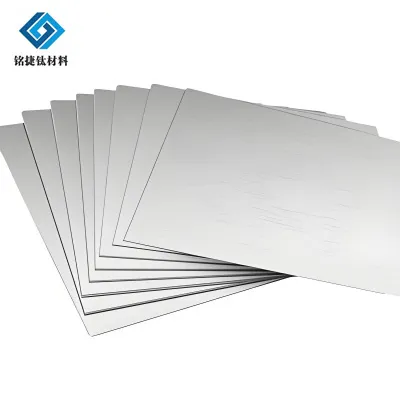
What are titanium plates used for?
1,Titanium plates range in thickness from 18 mm, 20 mm, to 50 mm.
As a silvery-white transition metal, titanium plays a crucial role in modern industry due to its superior properties. Titanium plates, as one of the main forms of titanium materials, are widely used in aerospace, medical, chemical, and construction industries. This article will provide a comprehensive overview of the characteristics, classifications, manufacturing processes, applications, and future development trends of titanium plates, aiming to help readers gain a thorough understanding of this important material.

Titanium has a high melting point of 1668℃ and a low coefficient of thermal expansion, which allows it to maintain stable performance even at high temperatures. Furthermore, titanium possesses excellent machinability, enabling it to be processed into various shapes of sheets through forging, rolling, welding, and other techniques. These properties collectively give titanium sheets a significant competitive advantage, making them an indispensable key material in modern industry.

2. Classification of Titanium Plates
Titanium plates can be classified into several types according to different standards. Based on chemical composition, titanium plates are mainly divided into two categories: pure titanium plates and titanium alloy plates. Pure titanium plates are further subdivided into grades such as TA1, TA2, and TA3, with purity decreasing and strength increasing accordingly. Pure titanium plates are widely used in chemical equipment and building decoration due to their excellent plasticity and weldability. Titanium alloy plates are made by adding elements such as aluminum, vanadium, and molybdenum to pure titanium to enhance their properties. Common grades include TC4 (Ti-6Al-4V) and TC11 (Ti-6.5Al-3.5Mo-1.5Zr-0.3Si). TC4 titanium plate, as one of the most commonly used titanium alloys, combines high strength, excellent heat resistance, and corrosion resistance, and is widely used in aerospace and medical fields. Its tensile strength exceeds 895 MPa, and its operating temperature can reach 400℃.

Based on differences in manufacturing processes, titanium plates can be divided into two categories: hot-rolled plates and cold-rolled plates. Hot-rolled plates are rolled above the material's recrystallization temperature, and their thickness is generally greater than 3 mm, possessing high strength and toughness. Cold-rolled plates are rolled at room temperature, resulting in a thinner thickness (usually less than 3 mm), and offering superior surface finish and dimensional accuracy. In addition, there are titanium composite plates. These plates are formed by combining titanium plates with other metals such as steel and aluminum through explosive welding or rolling composite processes. They retain the corrosion resistance of titanium while incorporating the high strength of the base material, and are commonly used in chemical equipment and marine engineering fields.

3.Titanium plate manufacturing process
Titanium Plate Production Process The production process of titanium plates is relatively complex, encompassing multiple steps including sponge titanium preparation, smelting, forging, rolling, and subsequent processing. First, sponge titanium is produced from titanium ore using the magnesiothermal reduction method or electrolysis. Then, the sponge titanium is crushed, graded, and mixed with alloying elements, before being smelted into titanium ingots in a vacuum arc furnace or cold hearth furnace.

Titanium ingots undergo multiple forging processes to form slabs. These slabs are then processed into titanium plates of the target thickness using hot or cold rolling. Hot rolling is typically performed above the β-phase transformation temperature of titanium to reduce deformation resistance; cold rolling is specifically used for producing thin plates and high-precision sheets. During rolling, temperature and deformation must be precisely controlled to prevent defects such as cracks or uneven microstructure.

After being rolled into shape, titanium plates require a series of subsequent treatments, including annealing, straightening, and pickling. Annealing effectively eliminates processing stress and optimizes the material's microstructure and properties; pickling aims to remove the surface oxide layer and improve the surface quality of the plate. For certain special applications, titanium plates may also require surface treatments (such as anodizing or spraying) to enhance their corrosion resistance or improve their visual appearance.
Titanium and its alloys have wide applications in many fields due to their unique properties. Here are some of the main uses of titanium:
In the aerospace field

Titanium and titanium alloys exhibit exceptional toughness, with a hardness comparable to steel, resulting in significantly superior mechanical strength compared to other alloy materials, making them arguably the most ideal high-strength materials. Titanium also has a low density, being only about half that of steel as a lightweight metal. Replacing the alloy steel extensively used in aircraft structures with titanium alloys could reduce weight by approximately 40%.
In the field of medical devices
Titanium has excellent biocompatibility and will not cause rejection when in contact with the human body. Based on this property, titanium is widely used in the manufacture of various medical devices, such as implants and dental restoration materials .

Marine facilities
Titanium performs well in seawater environments and hardly corrodes. For this reason, titanium is often used to manufacture marine facilities and ship components.

Jewelry and fashion industry
Titanium has a wide range of colors. After oxidation treatment, its surface can display a variety of colors, which is one of the important reasons why titanium has been favored in the jewelry and fashion industry in recent years. People have begun to use titanium to make bracelets, necklaces and other jewelry, and even mobile phone cases .

Environmental protection projects
With its excellent corrosion resistance and biocompatibility, titanium performs well in environmental protection applications such as wastewater treatment and air purification .
Military applications
Titanium can be used as electrodes and power plant components, as well as environmental pollution control devices .

In the field of steelmaking
Titanium can be used as a deoxidizer in the steelmaking process, and it is also an important component of stainless steel and alloy steel .

In the pigment and paint field
Titanium dioxide is a high-quality raw material for making pigments and paints .
In the field of cemented carbide materials
Titanium carbide and titanium hydride are new cemented carbide materials .
In the field of decoration
Titanium nitride is close to gold in color and has a wide range of applications in the field of decoration .

In conclusion, titanium has a wide range of applications, covering aerospace, daily necessities, medical and health care, and environmental engineering, fully demonstrating its unique value and significant advantages.
Titanium, a silvery-white transition metal, is used in modern industry for 18mm, 20mm, and even 50mm thick titanium plates due to its superior properties. Titanium plates, as a key form of titanium material, have wide applications in aerospace, medical, chemical, and construction fields. This article will systematically describe the characteristics, classification, production processes, application areas, and future development trends of titanium plates, helping readers gain a comprehensive and in-depth understanding of this important material.